North Shore: Three Tables & Shark’s Cove

Summer is snorkel time on Oahu’s North Shore. Winter waves can reach 50 feet or higher, and completely wash out the highway, but starting in spring the ocean calms to the clear, warm water that Hawaii is known for. Most of the shoreline is safe for swimming during this time of year, but two places stand out for snorkeling. Three Tables (named for three flat rock formations visible in the water) and the adjacent Shark’s Cove (a rocky, shielded inlet with no sharks whatsoever) offer some of the most accessible snorkeling on the island. Both locations are rocky, which is a good thing since rocks give coral a place to grow and fish places to hide, but it does mean that water shoes are required along with sunscreen and plenty of drinking water. The shoreline has a little shade, but it isn’t great for sitting in — many of the trees drop thorns.

Shark’s Cove is the shallower location. It is also rockier and it can be tricky wading in and out of the inlet (wearing fins not recommended). Visitors must take care not to step on the boulders and damage the coral, but since the water is rarely deeper than waist-high it can be difficult to keep balance. I learned the hard way after tripping and accidentally kicking my pregnant sister in the head; please, be cautious wading in! Still, the cove is nearly cut off from the sea by large boulders, so it also tends to be more sheltered and forgiving to unconfident swimmers. The northern side of the cove drops sharply and becomes significantly deeper; it also contains the only passage to the sea. More skilled snorkelers and divers often swim this to investigate the reef outside of the cove, but this is not recommended for beginners. The waves funneling through the narrow lava passage are amplified and rip currents are always a risk, so most visitors are better off keeping to the southern half of the cove. Even without chancing the open ocean, however, Shark’s Cove still has plenty to see – octopus, eels, butterfly fish, unicorn fish, tangs, and of course, the famous humuhumunukunukuapua’a, the state fish of Hawaii.

At Three Tables, you will likely share the sea with divers. Three Tables still has shallow areas, but there are frequent, dramatic drop-offs, and most of the beach goes deeper than 10 feet. I float easily, so the one time I dropped my snorkel, I had to beg a complete stranger wearing fins to dive and retrieve it for me; I could not get to the seafloor, even with a friend trying to push me deeper. It might be difficult making it past the breakers to the snorkeling area wearing fins, but for the brave, it could be worth the effort. Three Tables often sees large schools of fish stopping through, and Hawaiian green turtles, honu, are common.

Be wary of tides at both locations and observe the water and other swimmers before going in. Three Tables and Shark’s Cove are frequently glass-smooth, but waves crunched me at both beaches when I was too impatient about getting in. Also be aware that Hawaii’s unicorn is North Shore beach parking – be patient looking for spaces and be gracious about sharing the road. Watch for pedestrians. With the proper precautions, you’ll be able to enjoy a wonderful day in the water.
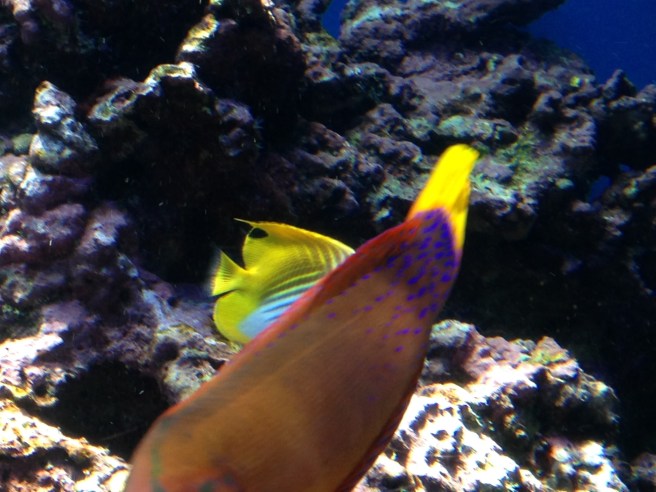
IMG_0530
What typically happens when a nearsighted person tries to use an underwater camera, except this was taken at an aquarium and therefore slightly less blurry.

North Shore: Opal Thai

The Opal Thai restaurant in the North Shore village of Haleiwa is known for a few things: a line out the door, delicious food, and a charismatic chef who does not allow new visitors to order their own food. Opal, the owner and cook, takes his time interviewing customers at each table. He runs down a list of basic ingredients (“You like rice? Noodles? Fish? Chicken? Duck? Tofu? Spice or no spice?”), remembers the answers, then disappears back into the kitchen to create a meal suited to those tastes. My first visit, during a dual birthday celebration, included one guest who, when asked whether she liked Thai food, sheepishly told Opal no. His response:

“You know why you don’t like Thai food? Last time you had it, the guy in the kitchen was Chinese and told you he was making Thai!”

Our guest, a notoriously picky eater, had to admit at the end of the meal that a few of the entrees had been “pretty good.” The rest of us were raving. It also happened to be my first time ever trying Pad Ke Mao, Drunken Noodles, which is a recipe I loved and have completely failed to either recreate on my own or find at the same quality anywhere else.

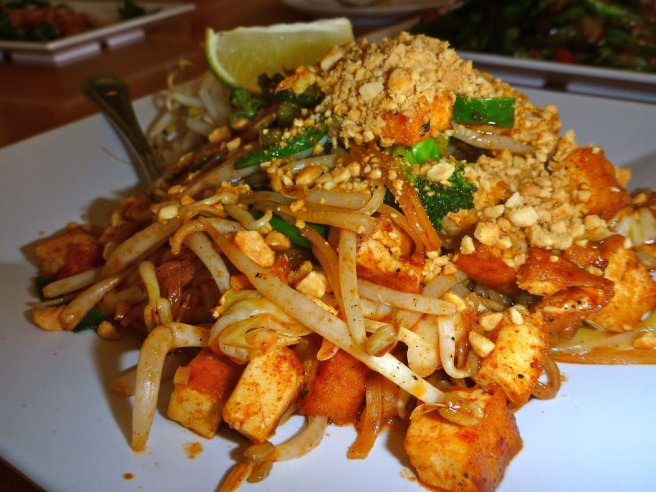
I was lucky to visit Opal’s frequently enough to be allowed a menu; none of the dishes ever disappointed. And Opal kept himself involved. One time, I was enjoying my pad thai while he walked past my table. He stopped dead, reached for the lime wedge left on the plate, and squeezed every drop of juice on my noodles before sauntering away without saying a word. (Yes, the next bite tasted better).

My only complaints about the place are the wait times to be seated and that they insist on giving out these tiny water glasses that are not nearly large enough to help the average spice-averse Caucasian through a meal (for the record, I like spice and usually order meals at a Medium level, but it is uncomfortable with no water). I recommend bringing along a water bottle. Otherwise, you’re depending on the mercy of the waitstaff, who can be slow with refills.

Note: Opal’s success led to the restaurant opening a location in Honolulu, and it seems a food truck! Reviews indicate that food quality hasn’t changed.

Opal_Thai_Food8
From opalthai.com; check the menu!


The Truth About Pearls

While enjoying a tropical vacation, pearls are often the souvenir of choice, which makes sense – they are beautiful reminders of the ocean and the salt spray always lingering in the air. But most people have no idea what to look for, and I am a certified specialist through the CPAA (Cultured Pearl Association of America), so I am here to help. Some things to know:

They are very often not round, very often not white, and you’ve probably paid too much for them.

Pearls get a bad rap. Partially this is deserved; most people have only been exposed to the pearls sold in chain jewelry stores. Employees of these stores almost never have any specific training on pearls, and the owners tend to buy what is available fourth-hand (bought from someone who bought from someone who bought from someone who bought it from the dealer). The result is dull, poor-quality pearls priced multiple times what they are worth.

There are multiple online stores dedicated solely to pearls, with owners who buy directly from growers and dealers and thus are able to sell to customers at much more reasonable prices. I have had good experiences with Pearl Paradise, Pearls of Joy, and Kojima Pearl, but there are many other companies that specialize in pearls and have good reputations. And of course, sometimes you stumble upon excellent pearls even in ordinary jewelry shops; the trick is knowing what you’re looking at.

So, what to look for? Here are some qualities, in order of importance from low to high:

  1. Shape. Round pearls have greater value because they form more rarely, but shape alone is not a deal-breaker. Many, many people love button pearls because they rest more comfortably against the body; others are fans of drop shapes for their unique aesthetic. And of course there are the “free-form” pearls that have their fans, such as fireballs, which make fascinating pendants, and natural “keshi” pearls whose small, uneven shapes are suited very well for less formal jewelry. The best advice to give here is to buy what you like.
  2. Size. Again, not a deal-breaker. Some people look better in smaller pearls or find them more comfortable to wear. Larger, good-quality pearls will be worth more, but smaller pearls more often have good surface quality and sharp luster. They are also much lighter. Keep in mind, too, that because a pearl is roughly spherical, and has volume, it is going to look larger than its dimensions would suggest. Buy what you like.
  3. Surface. Pearls form by turning inside the oyster so layers of nacre can be deposited, which often results in pits or grooves on the surface of the pearl. A perfectly smooth pearl is quite rare and therefore worth more, but a pearl doesn’t have to be smooth in order to make good jewelry. Very commonly, one side of the pearl is flawed, and this side is simply set to the back so it is against the wearer’s skin and not showing.
  4. Orient. Pearls have an iridescent color play on the surface similar to the sheen on the surface of a bubble – this is called orient. A strong orient will add value, and it also just generally makes a pearl prettier. Orient is unique to pearls, and a quality that makes them famous. Tahitian pearls in particular are renowned for their orient, especially what is known as ‘peacock’: green and purple flashes layered over a dark gray surface. Japanese Akoya pearls also often have lovely orient, and more recently, even Chinese freshwater pearl growers have begun developing cultured pearls with orient. A pearl can still be nice without this, if the luster is sharp, but since orient is part of what makes a pearl a pearl, it ought to be celebrated and enjoyed.
  5. Luster. How shiny is the pearl? There is an easy test for luster: the more clearly a reflection can be seen in the pearl, the higher the luster. Luster is one of the most desirable qualities in a pearl (with the exception of South Sea pearls, which form differently and have a unique, soft appearance). A good luster will often lead to better orient as well and help the pearl stand out more against the wearer. Modern growers are frequently developing pearls that can even be called metallic. Many pearl fans ignore size, shape, and surface entirely in favor of finding pearls with good luster and orient. This allows them to purchase unique, lovely pearls at a fraction of the price and to also have pearl jewelry that doesn’t fit the “Grandma” cliché.

Finally, keep in mind that pearls come in many, many natural colors: white, pink, lavender, cream, silver, blue, pistachio, green, gold, gray, black, and even vibrant purple. A person wanting to wear pearls has countless options and does not need to go bankrupt to do it. So give pearls a try, and good luck with the hunt!

Some of the pearls I’ve met before:

Frozen Oahu

“It’s like eating a gummi bear with ice cream in it.”

This is probably the most accurate description of mochi ice cream I’ve ever heard, and if you’re ever in Hawaii, it’s a treat not to be missed. Bubbies has the best on O’ahu (two locations, one near the college in Manoa and one in Hawaii Kai). I can’t speak for the other islands, but Long’s Drugs is everywhere and they also sell mochi ice cream in the freezer section, although in the very basic flavors of vanilla, chocolate, coffee, and green tea. It’s not Bubbies, but it’s still good.

Bubbies’ campus location also carries other desserts, but I’ve never been tempted to order one because it forces people to say some very embarrassing names. Also, they are expensive. But mostly the first thing.

Favorite mochi flavors: sakura (mild, very faintly fruity/floral cherry), guava, lilikoi (passionfruit), honeydew (seasonal), chocolate mint (seasonal), and chocolate-covered strawberry. They’re all good though, you really can’t go wrong. And you can order online – or check Whole Foods! There isn’t one near me, but I’ve heard they carry Bubbies in the freezer section.

Other great frozen treats from the islands:

*Roselani ice cream, now available at stores like Longs and Walmart (in Hawaii). Maui-made, terrible for you due to the high fat content, and absolutely delicious for the same reason.

*Dave’s Ice Cream, which is less terrible for you but also delicious. Try the ube (purple sweet potato) flavor – it’s a bit like pralines and cream without the nuts, just a creamy, kind of nutty taste. If you get shave ice somewhere good, Dave’s is the ice cream they add.

*Halo halo – this Filipino Supreme Milkshake Sundae Smoothie is made the best at a little store in the Navy Exchange (NEX) food court, which does allow civilians to shop. Condensed milk, crushed ice, pieces of flan, jackfruit slices, and some berry I still haven’t identified are all stirred together then topped with Dave’s ube ice cream and whipped cream. YUM.

*Scoop of Paradise, in Haleiwa. They have some seriously delicious ice cream – my favorite flavor is rose. Yes, rose. It’s sweetly floral and perfect for a hot day; they also offer a lavender-based floral flavor that is nearly as good. Another favorite flavor is Blue Hawaii, which is a marshmallow-based vanilla. The shop doubles as a toy store and can be a great place to find children’s gifts, as many of the toys are Hawaii or ocean-themed.

*Shave ice. This stuff is classic, the real good goods. If it says “shaved” on the cart, or if you can see they’re giving people snow cones with big chunks of ice, save your money (by the way, don’t ever call it “shaved” yourself). Wait to go to a real place with ice shaved thin and mounded into a snowball. Matsumoto’s in Haleiwa is famous, but they also have great shave ice at the Aloha General Store near the Wyland gallery and in a nearly hidden nook right next to the Tropical Rush Surf Co. If you rent a paddleboard from Tropical Rush, you get a small shave ice for free, and trust me, it’s great after an hour or two going up and down the river. Just be sure to have a bit of extra cash on hand if you want to include a snowcap (condensed milk) or ice cream (again, they give you Dave’s).

*Melona bars. These aren’t strictly Hawaiian but are a creamy Korean import that I can only hope will reach the mainland soon. Their signature flavor is honeydew melon, but they also have mango, banana, and strawberry, and they’re all great. Pop into any store with a basic freezer section and you’ll probably spot a few.

Know Before You Go: Hawaii

So during my time in the islands I was employed at a business office serving the entire state (note: I was not employed at a state/government-run organization. So while we were the office for the state of Hawaii, we weren’t bossed around by the State of Hawaii. Make sense?). People never realized this, though, and at the front desk I got to field some pretty funny phone calls.

American Caller : “Do I need my passport?”
American Caller: “Do you take American money there?”
American Caller: “Do people speak English?”
American Caller: “How long does it take for lava to go away? How much does it cost to get rid of it?”

I think it important to note that I never had a stupid call from a foreign caller; the only one that came close was a guy from India who was trying to figure out what he needed for his passport. Which, of course, had nothing to do with our office, but sometimes it’s hard to know where to go so that’s understandable. My fellow countrymen, however, should know better. WAY better. They’re supposed to teach you the 50 states in elementary school; if you’re an American reading this blog and are shocked to discover that Hawaii is a state, you either need to go back to school sitting at the front of the class or have a very severe talk with whichever teacher let you down.

Even some of these silly questions are somewhat understandable, though, especially for people who aren’t familiar with what Googling is or not fond of libraries. And, you know, in a lot of ways Hawaii does feel like a different country (for good reason, I’ll get to that in another post), so it makes sense that people wouldn’t know how many islands there are or where the active volcano is right off the bat.

The calls that really bugged me were actually from repeat visitors. I.e., people who had been here before and still didn’t know basic information. I had a really snippy, fussy lady freaking out on the phone with me because she wanted to find an expensive restaurant in Waikiki where she could wear a really expensive dress out to dinner because…shewasafairyprincess,Iguess, and it wasn’t in my job description at ALL to search this kind of thing for needy people, but I did anyway, and I made the mistake of saying that I was checking out recommended restaurants on O’ahu. She blew up, saying over and over that she wasn’t going to O’ahu.

Me: “…You said you’d be in Waikiki, right?”
Her: “Yes, Waikiki! Not Honolulu! Not Oahu! When I was there in the 80s –”

I cut her off right there and gave her the kindergarten explanation I am now giving to you.

Me: “Waikiki is a neighborhood. Which is part of the city of Honolulu. Which is on. The island. Of O’ahu.”
Her: “…..Oh!”

TRAVEL TIP #1: For the love of God, do your research.
This applies to anywhere you might like to visit, not just Hawaii. I don’t care what you do, so long as you don’t call up some poor sap who’s being paid to do something else and bother them with questions you could find answers to yourself. Go to your library and look up travel books. Go to WalMart or a bookstore and ask if you can order a map. Use The Google to figure out the state’s travel website or visitor’s bureau. Something. Anything.

For the record, the official Visitor’s Resource for Hawaii is www.gohawaii.com.  Nice and easy, with a really fantastic layout to help you decide what you might like to do (it’s organized by island, then by region on island, AND by types of activities – outdoor, historical, cultural, etc). And you can download or request visitor’s material right from the website! They also have a phone number, but Hawaii’s in a wacky time zone from the rest of the states, the lines are always busy because of people who only want to use phones, and I’m tired of giving it out to people. If you want it, you’re gonna have to use the Internet at least once. 😛

Point is, it’s a really, really good idea to try to familiarize yourself with a place before deciding you want to visit it, and definitely before buying plane tickets. Otherwise you’ll end up like the lady who called in distress because her flight had landed in Honolulu (O’ahu), and she’d wanted to see the Merrie Monarch festival in Hilo (Hawaii Island).

Which brings me to TRAVEL TIP #2: Sort out the difference between Hawaii (The State) and Hawaii (The Island).

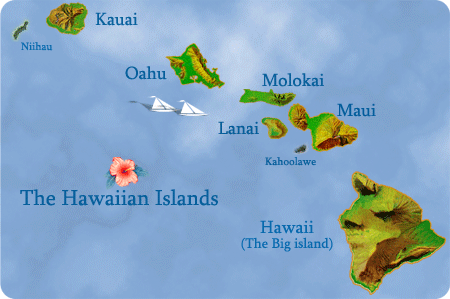
So here’s the deal. Hawaii is a STATE made up of 8 major islands. The islands are named, in order from north to south, Ni’ihau, Kaua’i, O’ahu, Moloka’i, Maui, and Lana’i, with tiny, uninhabited Kaho’olawe kinda hanging out right there. The last and biggest island is named Hawaii. This island is larger than all of the other 7 put together at some 4000ish square miles. It’s huge. It’s awesome. It’s the one with the active volcano and Volcanoes National Park and Hilo City and the Merrie Monarch Festival, it’s been around for a long time, and the entire state is named after it. Got it?

Here, have a visual aid.

For some reason mainlanders find this incredibly confusing, and instead of always calling it Hawaii Island, locals probably got tired of explaining this over and over again and nicknamed it the Big Island hoping it would help.

It didn’t.

-Hello world!

Aloha!

I’m Haley, I move a lot, and my hair is always in my eyes. Hence a friend’s suggestion for calling my blog “Wandering Sheepdog”.

I couldn’t exactly argue with that, especially because I’d been the one to refer to myself as a sheepdog in the first place, so Eden, here it is. I hope you’re happy.

-WS.